
Patriot Outreach Supporting all Military Service Men, Women, Retirees, Veterans, Government Civilians, Battlefield Contractors and their Families. |
| Home | My Story | Get Help | What's Happening | About Stress & PTSD | News & Reports | Donate | Mission | Contact |
 |

FM 22-51
LEADERS' MANUAL FOR COMBAT STRESS CONTROL
CHAPTER 1
OVERVIEW OF COMBAT STRESS CONTROL
1-1. Introduction
This chapter presents the concept and scope of combat stress control. It reviews historical
experiences with stress casualties in different intensities of conflict and looks et the potential
stressors in high-tech battles. It lists the responsibilities for combat stress control of all junior
(direct) and senior (organizational) leaders, staffs, chaplains, and health care providers. It also
discusses the responsibilities of specialized combat stress control/ mental health personnel.
NOTE
Battle fatigue and misconduct stress behaviors are preventable with strong effective leadership.
1-2. Combat Stress Control
a. Controlling combat stress is often the deciding factor-the difference between victory
and defeat-in all forms of human conflict. Stressors are a fact of combat and soldiers must
face them. It is controlled combat stress (when properly focused by training, unit
cohesion, and leadership) that gives soldiers the necessary alertness, strength, and
endurance to accomplish their mission. Controlled combat stress can call forth stress
reactions of loyalty, selflessness, and heroism. Conversely, uncontrolled combat stress
causes erratic or harmful behavior that disrupts or interferes with accomplishment of the
unit mission. Uncontrolled combat stress could impair mission performance and may
bring disgrace, disaster, and defeat.
b. The art of war aims to impose so much stress on the enemy soldiers that they lose their
will to fight. Both sides try to do this and at times accept severe stress themselves in order
to inflict greater stress on the enemy. To win, combat stress must be controlled.
c. The word control has been chosen deliberately to focus thinking and action within the
Army. Since the same word may have contrasting connotations to different people, it is
important to make its intended meaning clear. The word control is used (rather than the
word management) to emphasize the active steps which leaders, supporting personnel,
and individual soldiers must take to keep stress within the acceptable range. This does not
mean that control and management are mutually exclusive terms. Management is, by
definition, the exercise of control. Within common usage, however, and especially within
Army usage, management has the connotation of being a somewhat detached, numberdriven,
higher echelon process rather than a direct, inspirational, leadership process.
d. Stress is the body's and mind's process for dealing with uncertain change and danger.
Elimination of stress is both impossible and undesirable in either the Army's combat or
peacetime missions.
e. The objectives of stress control are as follows:
- To keep stress within acceptable limits for mission performance and to
achieve the ideal (optimal) level of stress when feasible.- To return stress to acceptable limits when it becomes temporarily disruptive.
- To progressively increase tolerance to stress so that soldiers can endure and
function under the extreme stress which is unavoidable in combat.f. How can stress be controlled? Stress is controlled in the same ways other complex
processes are controlled.
- Monitor the signs of stress and recognize when and if they change. To be
effective, this recognition should come well before the stress becomes disruptive
and causes dysfunction.- Identify and monitor the causes of stress; that is, the stressors. Stress and
stressors are defined in detail in Chapter 2.- Classify the stressors into those which can be controlled (increased, decreased,
avoided, or otherwise changed) versus those which cannot be controlled.- Control those stressors which can be changed by focusing the stress in the
desired direction, either up or down.- Help soldiers adapt to the stressors which cannot be changed.
- Learn (and teach) how to directly lower (or raise) the stress level within the
individual soldier as needed, at specific times, in specific situations.
1-3. Scope of Combat Stress Control
Combat stress control is much more than just a few stress reduction techniques which busy
leaders are supposed to learn from books or mental health workers and use now and then when
the stress seems intense. Army combat stress control activities must be a part of everything the
Army does. Combat stress control must be a natural part of the three continuums of Army life:
responsibility, location, and Army mission. Note that a weakness or gap anywhere in these three
continuums can cause weaknesses, overloads, or breakdowns in other aspects of Army life.
a. Responsibility. Responsibility for combat stress control requires a continuous
interaction that begins with every soldier and his buddies. It also involves the soldier's
family members. The interaction continues through the small team's combat lifesaver
(when there is one) and the combat medic. Stress control requires special involvement
from direct(small unit) leaders. The responsibility extends up through the organizational
leaders and their staffs (both officers and noncommissioned officers [NCOs]) at all
echelons. Appendix A describes combat stress risk factors and prescribes leaders' actions
to control them. Leaders, staffs, and individual soldiers all receive assistance from the
supporting chaplains, the medical personnel, and combat stress control/mental health
personnel (see Appendix B for information pertaining to combat stress control units). If
any link in the chain of responsibility is weak, it is the responsibility of the other
members of the chain to strengthen it.
b. Location. The location for combat stress control extends continuously --
- From the site of battle, disaster, or rigorous duty.
- Through the unit's forward and rearward support areas
- Through the communications zone (COMMZ), if present.
- To the continental United States (CONUS).
- To the unit's home station.
- To the rear detachment.
- To the family support group.
- To the Army hospitals and medical centers.
The location even extends to the Department of Veterans Affairs and veterans
organizations after the soldiers' discharge, medical separation, or retirement. Preventive
efforts, and also treatment for stress dysfunction, should be actively accomplished at each
location. If stress control is weak at any one location, this can cause stress and breakdown
not only there, but elsewhere in other locations.
c. Army Missions. The Army operations that require combat stress control are all
inclusive. They extend continuously --
- From garrison maintenance activities.
- To peacetime training exercises.
- To operations other than war.
- To war.
- To the integrated battlefield.
The same basic stress control principles apply across the entire range of Army operations.
Within our rapidly changing world, many Army units have had their missions shift across
a wide range of operations in a matter of weeks, sometimes with little advance warning.
Individual soldiers, family members, unit leaders and staffs, chaplains, and medics
(including the mental health/combat stress control teams) must be involved and work
together continuously. They must practice stress control against the frequent minor
stressors and the occasional severe stressors of peacetime. This, and only this, enables
them to be ready on short notice for the extreme stressors of war.
1-4. Historical Experience
Concept.
a. Origins of the Combat Stress Control
(1) Combat stress control is not new.
The basic leadership techniques which this manual will review were discovered
and taught by successful military leaders through the centuries and have long been
cornerstones of US Army leadership training. Combat stress control medical
doctrine for preventing and treating stress casualties is sometimes mistakenly said
to have originated from the Israeli Defense Force experiences in the 1970s and
1980s. Quite the contrary, the US Army learned that basic doctrine from its allies
during World War I (WWI).(a) The French and British discovered that if stress casualties were
evacuated far to the rear, many became chronic psychiatric cripples. If
treated quickly close to their units, most recovered and returned to duty.
The US Army Surgeon General of that time recommended that we adopt a
three-echelon system for prevention, triage, treatment, and return to duty
of stress casualties.1. First echelon. The US Army attached a trained psychiatrist to
each division. The psychiatrist's role was to advise command in the
prevention of stress casualties, to screen out the unsuitable, and to
assure that overstressed soldiers were rested and returned to duty
within the division whenever possible. Following British practice,
stress casualties in the division were labeled "Not Yet Diagnosed,
Nervous" (NYDN). This avoided even the suggestion of physical
injury implied by the dramatic popular label "shell shock" or the
implication of psychiatric illness conveyed by the official
diagnosis of "war neurosis." Under good conditions, 70 percent of
stress casualties were returned to duty within the division.
2. Second echelon. Behind the divisions in WWI, the US Army had
specialized neurological hospitals ( 150 beds) whose sole function
was to provide additional brief rest and rehabilitation to those
NYDN cases whom the division psychiatrist was unable to return
to duty. These neuropsychiatric facilities also provided brief rest
and rehabilitation to persistent cases of "gas mania" or "gas
hysteria" who believed they had suffered chemical injuries, even
though they had not been truly injured. About 55 percent of the
cases sent to these facilities returned to duty in an average of two
weeks.
3. Third echelon. Further to the rear was a specialized base hospital
which provided several weeks of additional treatment for cases
who failed to improve in the neurological hospital. It returned
many of those cases to useful duty.(b) The three-echelon system worked well, but on occasions when the
tactical situation interfered with forward treatment, it clearly showed the
superiority of the forward deployed part of the program.(2) The experience of WWI was forgotten between wars. It had to be rediscovered
in World War II (WWII) after several disastrous experiences when large numbers
of psychiatric casualties were overevacuated in the early battles. By late WWII in
the European and Mediterranean theaters, all divisions again had a division
psychiatrist with mental health assistants. The psychiatrist supervised a Training
and Rehabilitation Center in the division rear. The psychiatrists trained and
supervised the regimental and battalion surgeons in recognizing and treating
combat exhaustion or battle fatigue cases. Most regimental combat teams
(equivalent to our brigades) had an exhaustion center in the regimental trains area.
Many battalions maintained a rest area at the battalion field kitchens. The
surgeons supervised these facilities to assure that soldiers who were rotated back
to them recovered quickly and returned to duty. Behind the division there were
specialized clearing companies commanded and staffed by psychiatrists. These
clearing companies provided additional treatment for nonresponders or problem
cases. Specialized base hospitals were located in the COMMZ.
(3) Following WWII, the lessons learned were embodied in a table of
organization and equipment (TOE) unit, the mobile psychiatric detachment, or
"KO" team. These teams functioned very effectively in Korea.b. Experience in War.
(1) In the WWII Mediterranean and European theaters, the average incidence of
combat exhaustion casualties was one case requiring medical holding and
treatment for every four wounded in action (WIA) (a 1:4 ratio). In really intense
or prolonged fighting, the ratio rose to 1:2. On the Gothic line in Italy, the 1st
Armored Division suffered 137 combat exhaustion casualties for 250 WIA (a
1:1.8 ratio). Overall, with the correct treatment, 50 to 70 percent of combat
exhaustion casualties returned to combat within 3 days, and most of the remainder
returned to useful duty within a few weeks.
(2) During WWII the 6th Marine Division was involved in the Battle of Okinawa.
They fought day after day and were up against a determined, dug-in Japanese
resistance, rain and mud, and heavy artillery. The division suffered 2,662 WIA
and had 1,289 combat exhaustion casualties (a ratio to WIA of 1:2). Many of the
combat exhaustion cases were evacuated to Navy ships offshore and few of those
cases ever returned to duty.
(3) In the Pacific theater in WWII, there was about one neuropsychiatric casualty
evacuated from the theater for every one WIA (a 1:1 ratio). Many of these troops
appeared psychotic (bizarrely out of touch with reality). Most of these, however,
did not come from the combat units or areas. They were combat service support
(CSS) troops left behind by the war on the hot jungle or coral islands or the cold,
damp Aleutian Islands. The stressors were the combination of isolation,
monotony, boredom, chronic discomfort, and low-grade illness from the
environment, plus fear of disease, injury, and surprise attack. In retrospect, it was
realized that evacuating these bizarre stress reaction cases home only encouraged
more soldiers to "go crazy" when they temporarily reached their limit of tolerance
to stress. It would have been better to have sent them to rest camps close to their
units. This might have returned the majority quickly to duty, as was done with the
combat exhaustion cases in the European and Mediterranean theaters.
(4) It was also shown in WWII that tough training and esprit de corps prevented
many battle fatigue casualties. Elite units, such as the ranger and airborne units,
had less than one battle fatigue casualty for every ten WIA. This unit
cohesiveness prevailed even in combat assaults, such as Normandy and Arnhem,
where extremely high casualties were suffered. Unit cohesiveness also prevailed
during prolonged fighting like the Battle of the Bulge.
(5) During the Yom Kippur War (1973), the Israeli experience confirmed the risk
of stress casualties in the modern, high-tech, continuous operations (CONOPS)
battle. The Israelis counted on the high cohesion and training of their troops and
leaders to keep stress casualties to a minimum. They were caught, however, by
strategic and tactical surprise and were forced to mobilize on a religious (fasting)
holiday. They sent their reserves piecemeal into battle. Their Arab opponents,
whom they had previously discounted as inefficient, used massed artillery, armor,
and wire-guided missiles. The Arab units followed the Soviet CONOPS,
echeloned-attack doctrine. Israeli estimates of stress casualties suggest that large
numbers of Israeli soldiers, including veterans and leaders, became unable to
function solely because of stress. Stress casualties were frequent in the Golan
Heightsfighting, in the initial defense of the Sinai, and during the recrossing of the
Suez Canal. Since the Israeli Defense Force had no plans for treatment and return
to duty, all such cases were evacuated to hospitals in Israel. True to the experience
of WWI and WWII, many of these Israeli soldiers who were evacuated remain
psychiatrically disabled today.
(6) After the 1973 war, the Israelis instituted a model program of leadership
training and medical/mental health support. This was intended to prevent combat
stress casualties and to treat those cases which occurred in the brigade and
division support areas. However, in the 1982 Lebanon invasion, many cases were
inadvertently evacuated by helicopter to Israel in the initial haste of the invasion.
Few of these cases returned to full duty, while 60 to 80 percent of those treated in
Lebanon did.
(7) One Israeli armored battalion trapped in a desperate night action against the
Syrians had approximately 30 combat stress cases and 30 WIA (a 1:1 ratio). A
combat engineer battalion which was accidentally bombed by an Israeli fighterbomber
had approximately 25 killed in action (KIA) and 200 WIA. This same
battalion soon had 20 immediate combat stress casualties. Approximately 25 other
soldiers developed delayed stress reactions over succeeding days (a ratio to WIA
of 1:4.4). Even the Israelis' strong preventive program could not completely
prevent battle fatigue casualties in a high-tech war.c. Experience in Vietnam.
(1) In Vietnam, battle fatigue casualty rates rarely exceeded one per ten WIA. The
reasons for the few battle fatigue casualties included the sporadic nature of
fighting and our air and artillery superiority. Other factors were well-supplied fire
bases, scheduled rest and recuperation (R&R), and a fixed combat tour. All these
factors kept most battle fatigue cases at levels which could be treated in their units
and did not require medical holding or hospitalization.
(2) Other behavioral problems related to loneliness and frustration, however, were
associated with combat stress in Vietnam. Serious incidents of poor discipline
occurred, including commission of atrocities at My Lai(March 1968), combat
refusal, and even "fragging" (murder) of leaders. These events threatened unit
cohesion and the chain of command. By 1970-1971, when US ground forces were
rarely committed to offensive operations, "neuropsychiatric casualties," especially
drug and alcohol abuse and addiction, became epidemic. By September 1971,
neuropsychiatric cases accounted for over 60 percent of all medical evacuations
from the theater. Today those misconduct problems are recognized as having
contributed to the high incidence of delayed posttraumatic stress disorder (PTSD)
in Vietnam veterans. Due to the different nature of the stress, these types of
misconduct stress behaviors are more likely than battle fatigue in operations other
than war (conflict). These misconduct stress behaviors can seriously undermine
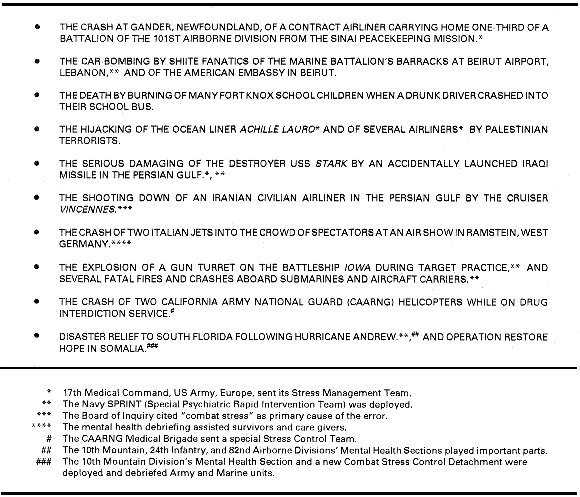
the objectives and successes of the mission.d. Experience in Catastrophic Events During Peacetime and Operations Other Than
War. Within the past few years, numerous accidents and hostile incidents have
demonstrated the value of crisis stress control for soldiers, their families, and civilians
caught in the turmoil of peacetime operations. Some recent historical events are listed in
Table 1-1. Unit leaders aided by post and hospital mental health personnel, chaplains, and
others played key roles in providing crisis stress control for many of these tragic
incidents. In the peacetime military, as in civilian police, fire, and disaster relief, stress
debriefing of critical incidents has proved its value in preventing and treating disabling
PTSD.
1-5. Effects of Battle on Soldiers, Units, and Leaders
a. War is fundamentally a contest of wills fought by men, not machines. Ardant Du Picq,
a 19th century French officer and student of men in battle, reminded us that, 'You can
reach into the well of courage only so many times before the well runs dry." Even before
that, Marshall De Saxe, writing in the 18th century, pointed out that, "A soldier's courage
must be reborn daily," and went on to say that the most important task of leaders was to
understand this, to care for and prepare soldiers before battle, and to use tactics during
battle which recognize that courage must be renewed.
b. Commanders must understand that in battle men and units are more likely to fail
catastrophically than gradually. Commanders and staffs, assisted by combat stress control
personnel, medics, chaplains, and others, must be alert to subtle indicators of fatigue,
fear, poor discipline, and reduced morale. They must take measures to deal with these
symptoms before their cumulative effects cause a unit to collapse. Staffs and
commanders at higher levels must be advised about the impact of intense or prolonged
combat on subordinate units. Military organizations can fight at peak efficiency for only
so long. Prolonged demands of combat cause efficiency to drop even when physical
losses are not great.
c. A unit may not be capable of performing its mission adequately if soldier resources are
depleted because --
- Vigilance deteriorates.
- Determinations and calculations become inaccurate.
- Reports become faulty.
- Decisions become slow and inaccurate.
- Orders are misunderstood/forgotten.
- Weapons are misused/underused.
- Maintenance and preplanning are forgotten.
Table 1-1. Examples of Catastrophic Events During Peacetime and Operations Other Than War
- Historic Incidents
- Maintenance and preplanning are forgotten.
- Motivation to perform duties decreases.
- Leaders' effectiveness decreases.
- Training becomes ineffective.
d. Degradation of soldiers' performance means that they lose a portion of their normal
effectiveness. Continuous, unrelieved operations and excessive stress degrade
performance and erode soldier resources. Combat capability is cut whether the unit is at
50 percent strength or at full strength with soldiers who are only 50 percent effective. As
individual and unit capabilities fall, battle fatigue may contribute not only to more battle
fatigue casualties but also to higher rates of wounds and disease and nonbattle injuries
(DNBI).
e. The skill and courage of leaders at all levels are critical to success in operations across
the full range of conflict. The chaos of combat places a premium on initiative, unit
cohesion, and mental and physical preparedness of soldiers and units. While the
importance of winning the first battle is great, the ability to fight sustained campaigns is
vital to deterrence and to victory. In war, temporary battle fatigue casualties are
inevitable but can be treated and returned to duty in or close to their units. In operations
other than war (conflict), the enemy threat counts on psychological stress and misconduct
stress behaviors to disable the defender. In operations other than war (conflict), drug and
alcohol abuse, other violations of military discipline, and criminal acts must be prevented
by strong leadership. Misconduct stress behaviors are dealt with through the legal system.
Medical care and treatment are provided when necessary.
1-6. The Potential High-Tech Battlefield
United States Army planners have predicted what future high-tech combat could entail. This was
demonstrated in the recent past with the world's confrontation with Iraq over the seizure of
Kuwait. Based on the current world situation, such future battles are not unthinkable. The
unprecedented debilitating effects of battlefield in the twenty-first century will demand even
more attention to the preparation of soldiers, crews, and leaders for combat hardships. In such
battlefields, the soldier will face many challenges.
a. Challenge of Isolation. The first challenge is isolation. Units may experience periods of
combat where forces are intermixed and lines of communication are broken. Units will
experience feelings of uncertainty and helplessness from unpredictable strikes by longrange
weapon systems. To make matters worse, these strikes may be inflicted by one's
own forces in the confusion of battle. The certain use of smoke and obscurants will limit
soldiers' vision, promoting feelings of separation, abandonment, and vulnerability.
b. Challenge of Higher Rates of Casualties from Conventional, Nuclear, Biological, and
Chemical Weapons/Agents. The increased rate of destruction of potential future
weaponry has both physical and psychological effects. Losing 40 to 60 percent of an
entire unit in minutes or hours could leave the remaining soldiers incapacitated. The rapid
and horrible death of their comrades and leaders could have a definite and detrimental
effect on the mental stability of the unit. Surviving soldiers will have to be prepared to
overcome the experience of mass human destruction. They will need to be trained to take
over from those lost and to reshape units that can continue to fight.
c. Challenge of Human-Technological Imbalance. The emergence of new technologies
has significantly increased the range of weapons, reduced reaction time, and changed
conditions over which battles are fought. This new technology has the potential to exceed
the capacity of human crews to fight.
- All-weather, day-and-night capable vehicles which can operate for extended
periods without resupply are limited only by the crews' need for sleep.- High-probability-of-kill, direct fire systems will be degraded over time by the
stress and fatigue levels of the men aiming those weapons.- Improved sensors and longer range weapons could exceed the capabilities of a
tactical headquarters to plan and execute battles fought over expanded areas of
operations.- Short engagement times and the increased lethality of new weapons could
overwhelm the ability of staffs to control and coordinate the overall battle.Soldiers, leaders, and staffs will face problems of reduced efficiency effectiveness when
fighting over extended periods. These conditions will tend to neutralize the potential gain
s of new war-fighting technologies and force new approaches to the preparation and
employment of soldiers, leaders, and staffs.d. Challenge of the Mental Rigors of Combat. Armies must initiate training programs to
help precondition soldiers to the mental rigors of combat. This is of vital importance as
the potentially catastrophic effect of battle stress in future warfare becomes evident. The
military force that does this best will have a decided edge in any war. Future combat will
strain human endurance to unprecedented levels. If these challenges are left unchecked
by poor mental and physical conditioning of soldiers, they could result in the disastrous
failure of entire units. Failure to consider the human factors in an environment of
increased lethality and uncertainty could cause a nation's concept of warfare to be
irrelevant. With the miniaturization and spread of high-tech (and perhaps even of nuclear,
biological, and chemical [NBC]) weapons, this can be just as true in operations other than
war (conflict) as in war.
1-7. Responsibilities for Controlling Combat (Conflict) Stress
a. Unit Cohesiveness Development. Rigorous, realistic training for war must go on
continuously to assure unit readiness. Emphasis must be placed on establishing and
maintaining cohesive units. Unit training and activities must emphasize development of
soldier skills. This development should focus on building trust and establishing effective
communication throughout the unit.
b. Senior (Organizational) Leaders' Responsibilities. The chain of command must ensure
that the standards for military leadership are met. Senior leaders must provide the
necessary information and resources to the junior leaders to control combat stress and to
make stress work for the US Army and against the enemy. Senior leaders' responsibilities
are listed in Table 1-2.
c. Junior (Direct) Leaders' Responsibilities. Junior leaders, and especially the NCOs,
have the crucial business of applying the principles of stress control day-by-day, hour-byhour,
minute-by-minute. These responsibilities overlap with senior leaders'
responsibilities but include parts that are fundamentally "sergeants' business," supported
by the officers.. See Table 1-3, page 1-11, for junior leaders' responsibilities.
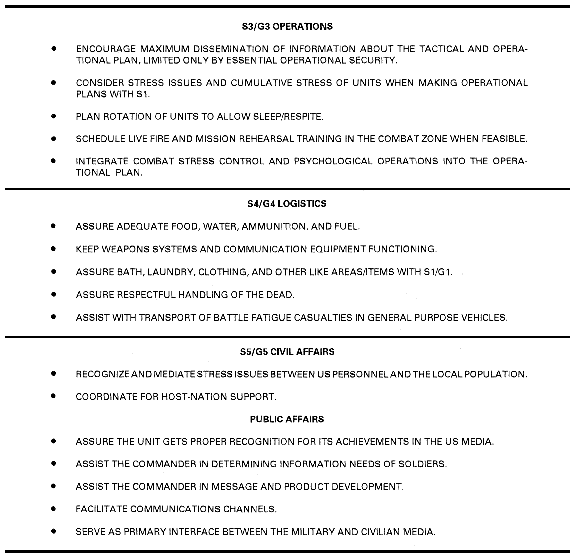
d. Staff Section Responsibilities. Each element of the commander's staff (adjutant,
intelligence, operations, logistics, and civil and public affairs [if present]) has its own
area of responsibility that has particular relevance to stress control (see Table 1-4, pages
1-12--13). For example, the adjutant's responsibility for mail and decorations is more
than just "nice to have." These are important stress control measures. Morale, welfare,
and recreation opportunities, and even the use of Army bands, are valuable ways to
sustain morale and combat readiness. For additional information on the role of Army
bands, see Appendix C.
Table 1-2. Senior Leaders' Responsibilities
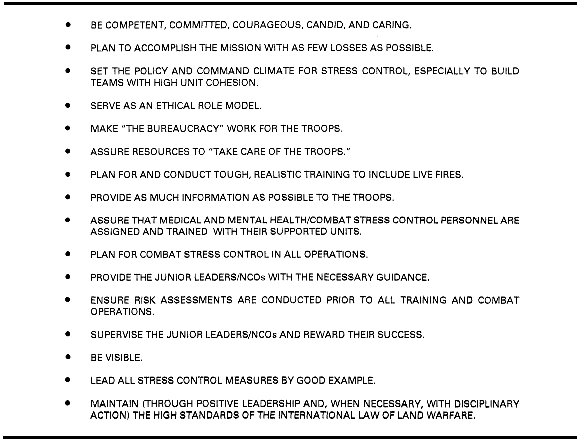
Table 1-3. Junior Leaders' Responsibilities - Combat Stress Control
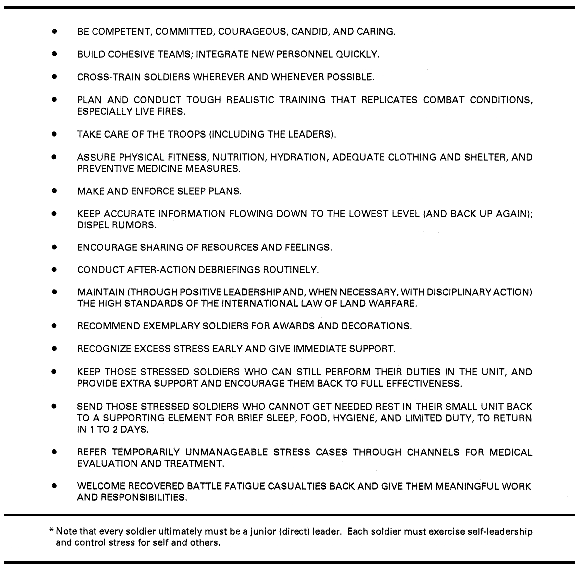
Table 1-4. Staff Responsibilities for Combat Stress Control
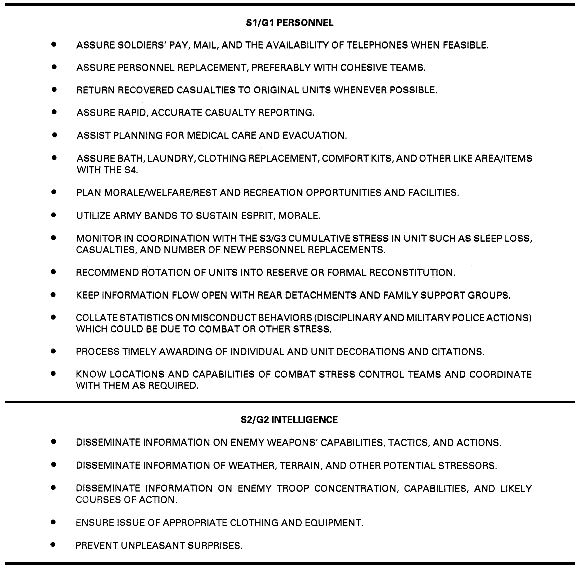
Table 1-4. Staff Responsibilities for Combat Stress Control (Continued)
e. Chaplains' Responsibilities. Chaplains, especially those in unit ministry teams, have
extremely important responsibilities. See Table 1-5 for chaplains' responsibilities. For
additional information on the unit ministry teams, see Appendix D.
f. Unit Medical Personnel's Responsibilities. Unit medical personnel assist commanders
and NCOs in the control of stressors. See Table 1-6, page 1-16, for combat stress control
responsibilities.
1-8. Primary Responsibility-Combat Stress Control/Mental Health Personnel
Combat stress control is the primary responsibility-in peace as well as in war-of the mental
health team. While the chain of command and NCO chain of support have ultimate responsibility
for stress control, the unit leaders must give primary attention to accomplishing their unit's
mission. Headquarters staffs and unit chaplains and medical personnel also have other primary
missions which must come first. Sustaining military performance, preventing stress casualties,
and treating stress symptoms are the primary missions for Army combat stress control units and
personnel.
a. Combat Stress Control Organization. As defined in Army Regulation (AR) 40-216, the
mental health team consists of Army psychiatrists, clinical psychologists, social work
officers, occupational therapy officers, psychiatric nurses, and their enlisted counterparts.
Mental health personnel are organized into organic mental health sections in the main
support medical companies of divisions and the medical companies of separate brigades.
In both the corps and the COMMZ, the mental health sections are organic to the area
support medical battalion. Mental health staff sections in the medical command, medical
brigade, and medical group monitor and coordinate combat stress control support. The
medical combat stress control units (companies and detachments) are a corps and
COMMZ asset. They are designed to divide into mobile, modular combat stress control
teams. The teams provide combat stress control support throughout the corps and
routinely deploy forward to reinforce mental health section personnel in the division and
brigade areas. The philosophy and the organizational and operational concept for combat
stress control are reviewed in Appendix B.
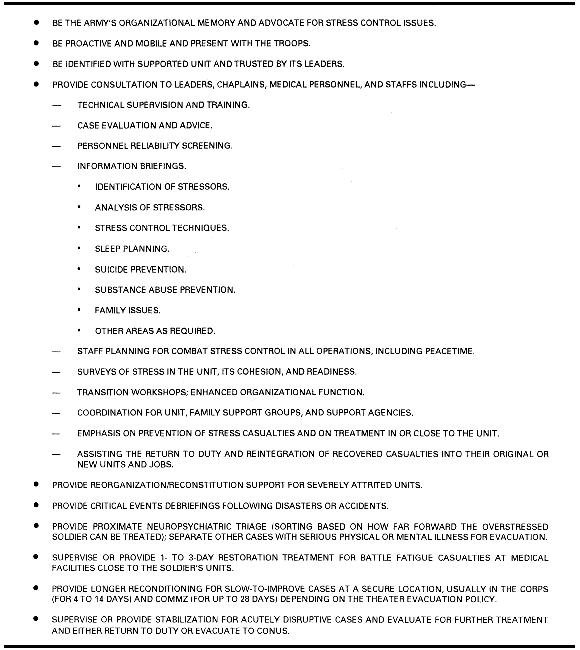
b. Combat Stress Control /Mental Health Team Responsibilities. Table l-7, page l-17,
summarizes the mission and responsibilities of combat stress control/mental health
personnel in combat stress control.
1-9. Effective Combat Stress Control Program
Without an effective combat stress control program, combat stress can be a "war-stopper" for our
soldiers. This may be by way of a high number of battle fatigue casualties during and after
intense critical battles. It may be by way of misconduct stress behaviors which undermine the
objectives and the will to persist in operations other than war (conflict). Maximizing the amount
of combat stress experienced by our forces is one of the main objectives of the enemy. An
effective combat stress control program requires participation at all levels. It is implemented by
command authority. It is supported by commanders, leaders, staffs, chaplains, physicians, and
health care providers and should be facilitated by mental health/combat stress control personnel
and units. Through these actions we can control the effects combat stress has on the
accomplishment of unit missions by --
- Identifying and controlling stress factors (stressors).
- Reducing number of battle fatigue casualties and misconduct stress behaviors.
- Reducing recovery time for battle fatigue casualties.
An effective combat stress control program focuses the effects of combat stress toward
increasing positive stress responses while decreasing disruptive stress. It reduces the possibilities
of stress becoming a war-stopper for the US.
Table 1-5. Chaplains' Responsibilities for Combat Stress Control
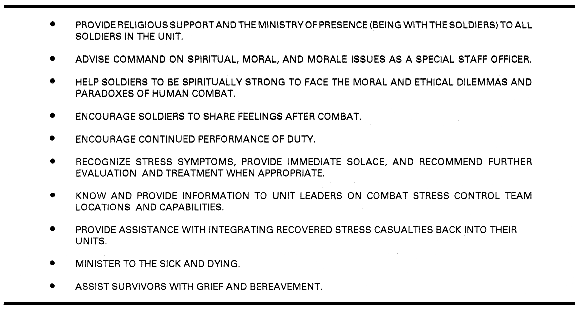
Table 1-6. Unit Medical Personnel's Responsibilities for Combat Stress Control
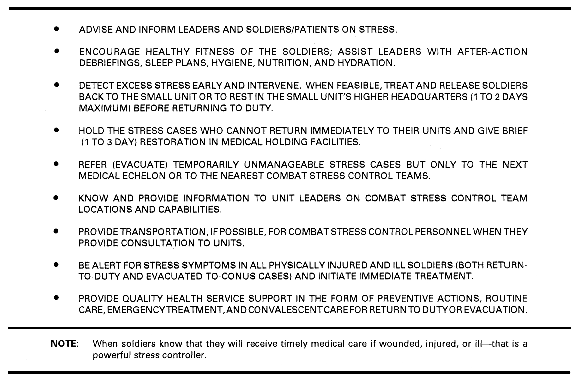
Table 1-7. Combat Stress Control Unit and Mental Health/Combat Stress Control Personnel's
Responsibilities
Go to Chapter 2 - Stress and Combat Performance
FM 22-51
LEADERS' MANUAL FOR COMBAT STRESS CONTROL
Table of Contents
Preface
Chapter 1 - Overview of Combat Stress Control
Chapter 2 - Stress and Combat Performance
Chapter 3 - Postive Combat Stress Behaviors
Chapter 4 - Combat Misconduct Stress Behaviors
Chapter 5 - Battle Fatigue
Chapter 6 - Post-Traumatic Stress Disorder
Chapter 7 - Stress Issues in Army Operations
Chapter 8 - Stress and Stressors Associated with Offensive/Defensive Operations
Chapter 9 - Combat Stress Control in Operations other than War
Chapter 10 - War and the Integrated (Nuclear, Biological and Chemical) Battlefield
Chapter 11 - Prevention of Battle Fatigue Casualties and Misconduct Stress Behaviors
Appendices
Appendix A - Leader Actions to Offset Battle Fatigue Risk Factors
Appendix B - Organization and Functions of Army Medical Department Combat Stress Control Units
Appendix C - United States Army Bands
Appendix D -The Unit Ministry Team's Role in Combat Stress Control and Battle Fatigue Ministry
Appendix E - Example Lesson Plan
Glossary - Abreviations and Acronyms
References - Sources Used

 Home
Contact
Get Help
What's Happening About Stress and PTSD
News and Reports
About Patriot Outreach
Donations
LifeLine Resources
Our Mission
Podcasts
Links and Banners - Link to Patriot Outreach
Home
Contact
Get Help
What's Happening About Stress and PTSD
News and Reports
About Patriot Outreach
Donations
LifeLine Resources
Our Mission
Podcasts
Links and Banners - Link to Patriot OutreachWrite to us at Patriot Outreach, PO Box 601, Selma, OR 97538
or
Call Toll Free: 1-866-96-STRONG (866-967-8766) (8am to 4pm Pacific Time) Email: info@PatriotOutreach.org
Copyright 2006-2011 Patriot Outreach